53 about curriculum herofull web scaled 1

HighReach Learning Curriculum Overview

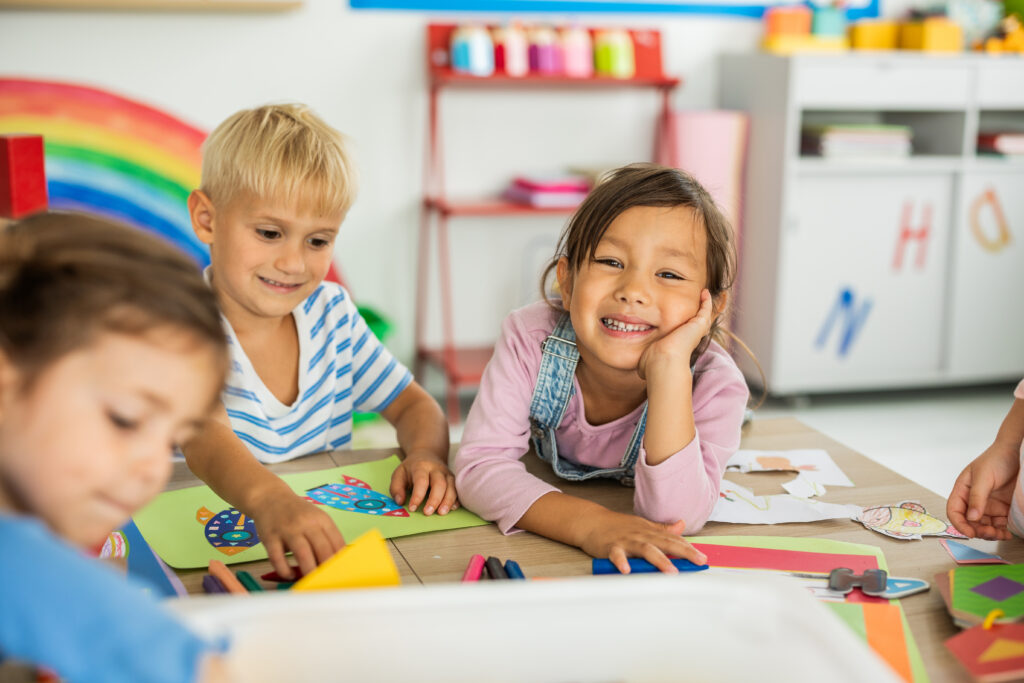
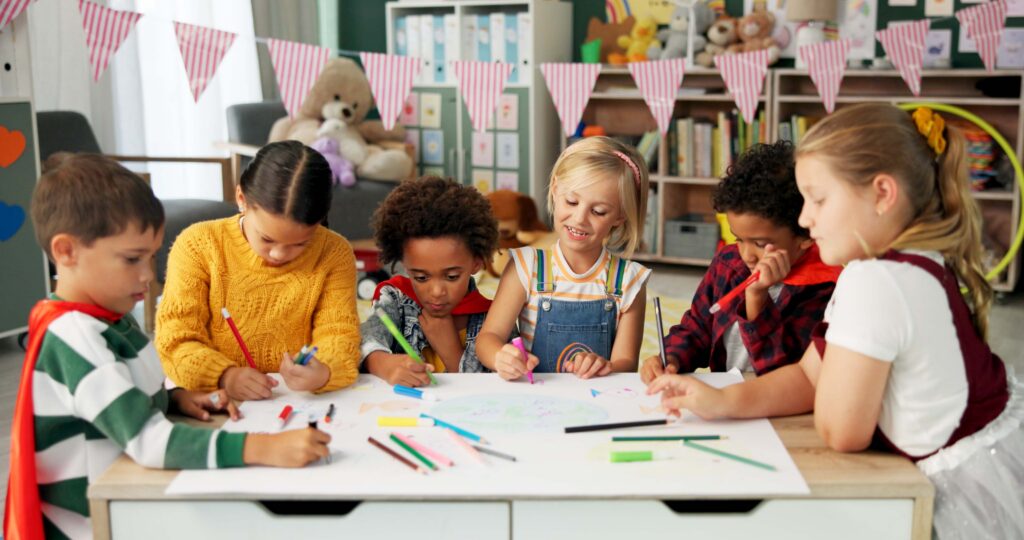
Our child-centric educators are adventure-architects. They help your child grow by creating exciting adventures, crafting engaging activities and sparking curiosity to ignite a sense of wonder in every child. Our proprietary HighReach Learning curriculum is based around the idea that children learn best when they are actively engaged in hands-on experiences, exploration and play.

Through a combination of structured activities and child-initiated play, we foster a love for learning and help children develop essential skills. Our curriculum is proven to give students a great start in early development and create meaningful learning opportunities. Plus, our supportive educators empower each child to embrace the world with enthusiasm and curiosity, nurturing their growth and giving them the knowledge and skills for success in school and beyond.
24 about curriculum2 web

Infants (Bright Baby)

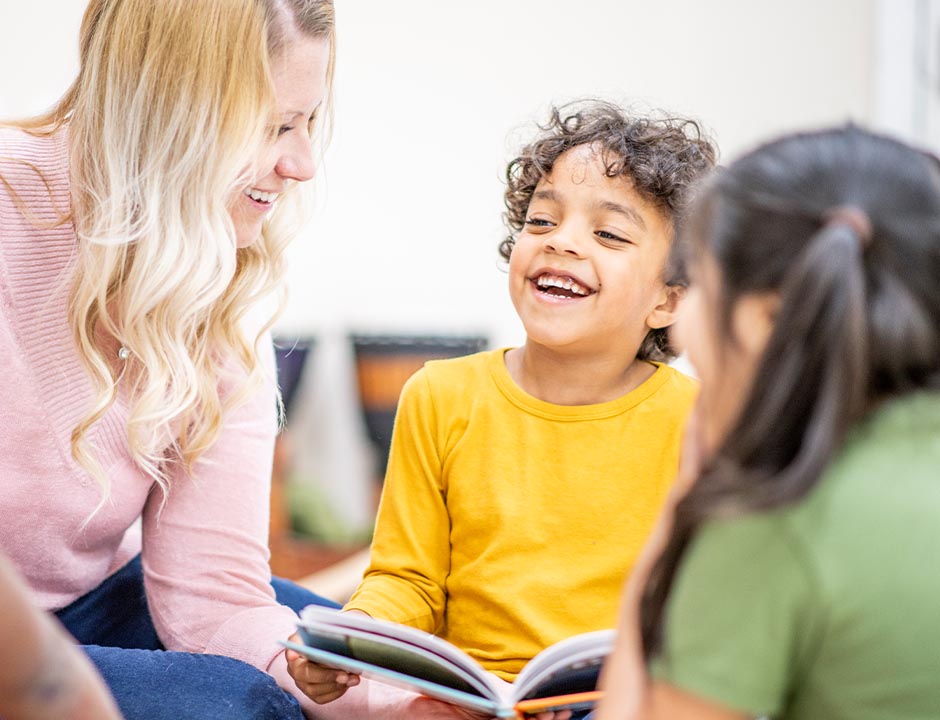
Our infant program nurtures your child’s growth through a milestone-based curriculum designed by experienced educators to advance their development. Daily, research-informed practices—including reading, singing, and early communication skills with American Sign Language—support early language, motor, cognitive, and social-emotional skills in a safe and nurturing environment.

Our Bright Baby infant program provides a warm, nurturing environment where your child can safely explore and grow during their earliest stages of development. Because we are more than just a daycare, we offer a variety of early learning experiences designed by experienced educators. Our evidence-based curriculum fosters key developmental milestones through structured activities such as reading, singing, and early communication skills through introductory American Sign Language, ensuring your baby receives the best start to their education journey. We are dedicated to giving you peace of mind, knowing your child is in caring, dedicated hands.
Each day is filled with joy and discovery. Our experienced caregivers partner with you to create individualized, nurturing routines that build a strong foundation for infant development. Through sensory play and responsive interactions like talking, reading, and tummy time we support your child’s growth across all areas of development . You will see your baby build early language skills through babbling and listening,build nurturing and trusting relationships , and help develop crucial gross motor skills by rolling, crawling, and standing. Our approach to infant childcare focuses on cognitive growth by encouraging curiosity and problem-solving, creating the perfect place for your little one to flourish.
We are honored to be your partner in this precious stage of early development. Our commitment is to provide a secure, happy, and nurturing environment where your infant can learn and thrive.

Read More

Learning Domains

Development/Emergent Literacy

  • Experiments with sounds and babbling, building language skills
  • Uses voice to express feelings
  • Uses speech-like sounds; may begin to say words
  • Exhibits some sense of size, color and shape recognition of objects in immediate environment
  • Understands objects continue to exist even when they cannot be seen
  • Stacks toys/objects
  • Explores the world around them through their senses
  • Begins to explore food with hands
  • Becomes more aware of cause-and-effect relationships
  • Begins learning self-regulation and soothing skills
  • Differentiates between known people and strangers
  • Plays more interactively with others (peek-a-boo)
  • Focuses and reaches for objects
  • Begins developing problem-solving skills
  • Enjoys repetition of activities, practicing and figuring out how things work
  • Rolls over, grasps with both hands and begins to sit with assistance
  • Builds large muscles through crawling and standing
  • Walks with adult support; may begin to walk alone

Curriculum in Action

See how our educators teach our infant curriculum in the classroom.
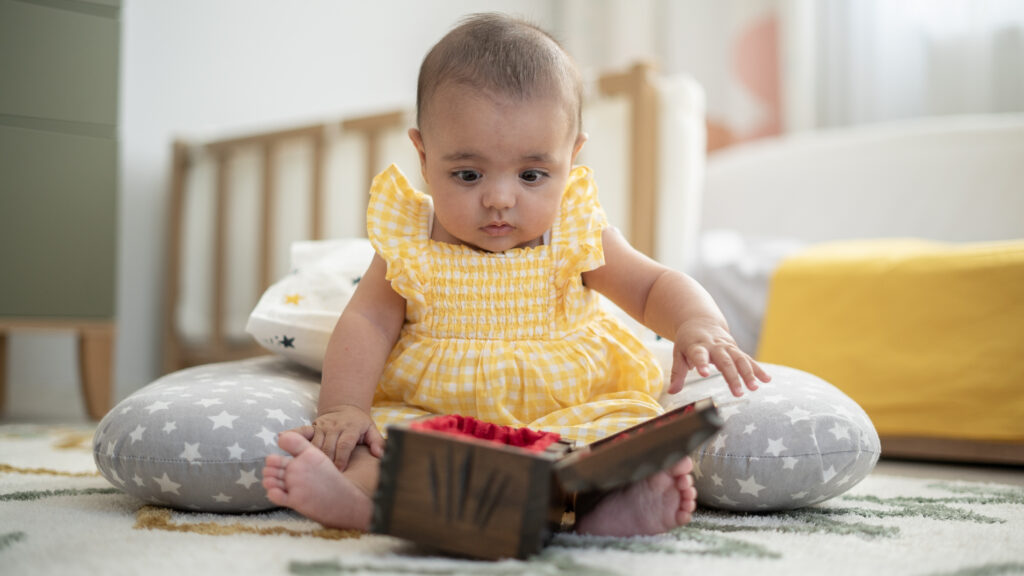
Activity: What’s in the Box?
Skills Developed: Observation, sensory exploration, fine motor skills, language development
Learning Experience: Teachers create a small “mystery box” using familiar classroom items such as rattles or balls. The box is gently shaken to capture infants’ attention, followed by curiosity-building prompts like, “It’s dark in the box, I wonder what’s inside.”
Teachers model how to lift the lid and place it loosely on top so infants can practice opening the box themselves. This helps infants build early problem-solving abilities and supports the development of object permanence—the understanding that objects continue to exist even when not visible.

Read More

Sweet baby girl opening wooden box

Toddlers (Smart Steps Academy)

Our toddler program combines a milestone-aligned, play-based curriculum with the expertise of dedicated educators to foster your child’s growing independence. We balance structured activities, outdoor time, and child-initiated exploration within an intentional environment to develop crucial communication, social, motor, and cognitive skills.

Our Smart Steps Academy is designed for toddlers ready to explore, learn, and grow. We offer far more than a typical daycare; we provide a nurturing and engaging early learning environment that embraces your child’s growing independence and natural curiosity. Our experienced educators foster a love of learning through a balanced schedule of structured activities and child-initiated play. This approach promotes social, emotional, cognitive, and physical growth, ensuring every day is filled with bright smiles and the building blocks for a lifelong love of learning.
A day in our toddler childcare program is a fun-filled adventure. We create a supportive atmosphere where children develop independence and confidence through a blend of routines and child-led learning, with plenty of opportunities for outdoor play. Through play-based learning, your child will build crucial skills across key developmental areas. For example:
  • Enhancing language development by naming objects and experimenting with sounds
  • Practicing early math concepts like sorting and patterns
  • Using their senses to explore the world around them
Not only do we focus on building academic skills, we place emphasis on nurturing social skills like cooperation and empathy. While also building communication skills through self-expression and physical coordination through walking, climbing, and stacking. In our program, your toddler builds a strong foundation for their future educational journey in a safe, caring, and stimulating setting.
Read More

Learning Domains

Language and Emerging Literacy

  • Uses language to communicate with others (needs, opinions, feelings, etc.)
  • Shows awareness of sounds and language by playing with rhymes and singing songs
  • Enjoys books and stories
  • Begins to understand quantity like asking for more or comparing two groups of objects
  • Understands cause and effect
  • Begins to understand the concept of time, like before and after and daily schedules
  • Experiments with a variety of art experiences
  • Participates in a variety of movement activities, like dancing with control and imitating simple body movements
  • Engages in pretend play, like playing interactive games with adults or using dramatic play props
  • Demonstrates trusting attachments with adults
  • Begins to cooperate with others
  • Demonstrates emerging self-regulation, like self-soothing and beginning to show empathy
  • Shows curiosity about new things and new experiences
  • Uses a variety of problem-solving techniques
  • Shows increasing persistence when facing challenges
  • Improves fine motor coordination by manipulating materials, like stacking, building, or using writing utensils
  • Improves gross motor skills and strength, like walking without help, climbing, or kicking a ball
  • Builds self-help skills (eating, drinking, toileting)

Curriculum in Action

See how our educators teach our toddlers curriculum in the classroom.
Activity: Gifts Are for Giving
Skills Developed: Social and emotional development, cause and effect, hand-eye coordination
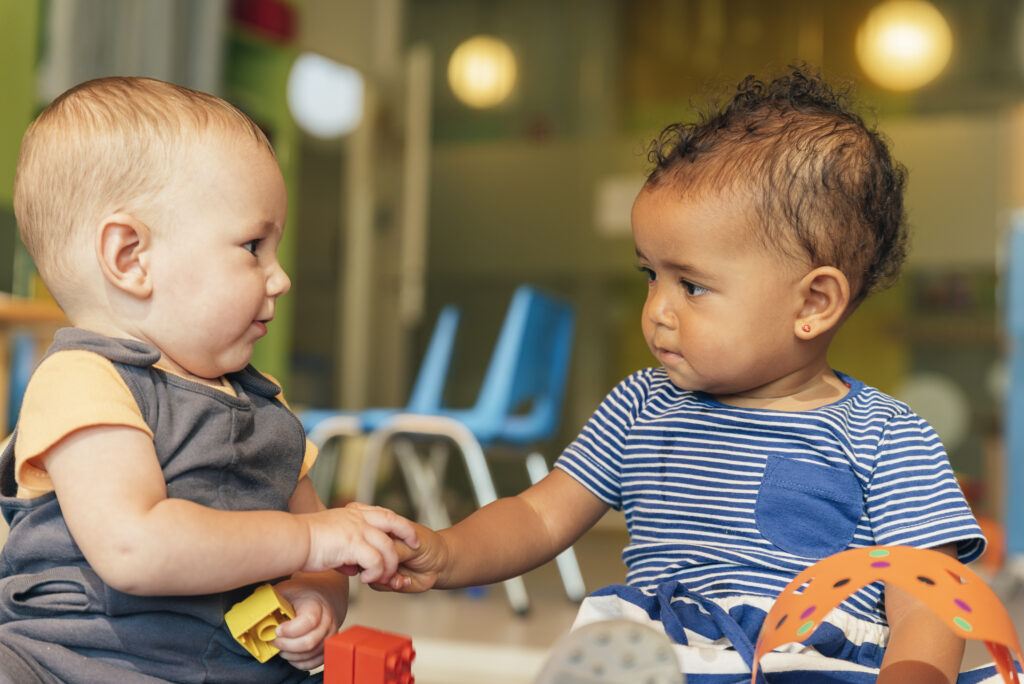
Learning Experience: Educators add small, colorful gift bags to the block area to create a playful and inviting learning opportunity. Toddlers enjoy filling the bags with blocks or other materials and then dumping them out. This repetition helps children understand cause and effect while practicing hand-eye coordination.
Toddlers may also choose to fill a bag and pretend to give it to another child or to an educator. When this happens, educators respond with warm appreciation to support social skills, sharing behavior, and early empathy.
Extension: Offer gift bags in different sizes so children can discover which blocks fit best. This encourages problem-solving and experimentation.
Adaptation: Educators model simple ways to interact with the gift bags, such as placing one block inside or gently tipping a bag to show how items come out. This guidance helps toddlers feel confident exploring the materials.

Read More

Babys playing together in the kindergarten.

Twos (Ready 2 Learn)

Designed by experienced educators, our program for two-year-olds channels their joy and curiosity into structured, play-based experiences that build crucial life skills. We target developmental milestones through thoughtfully planned activities—like singing, turn-taking in conversation, and exploring “why” questions—to advance language, social-emotional, cognitive, and motor skills in a warm, nurturing environment.

Our Ready 2 Learn program is specially designed for the wonderful world of two-year-olds, embracing their innate curiosity and energy. We provide much more than standard childcare; this is an early learning experience rooted in research-informed practices that nurture your child’s journey of discovery. Our dedicated educators create a safe, supportive environment where your two-year-old can explore, engage in imaginative play, and forge early social relationships. We believe in the power of hands-on exploration and a milestone-based approach to build a solid foundation for lifelong learning.
Each day is crafted to ignite your child’s mind through a blend of hands-on activities, like experimenting with letters and sounds, expressing themselves through various art mediums, and outdoor play. This two-year-old program focuses on key developmental goals across all developmental domains. Your child will enhance their language development by repeating words and taking turns in conversation, while building early preschool skills like sorting by color and shape. We encourage them to ask “why” questions and understand cause-and-effect as they explore science concepts.
A significant focus of our curriculum is social-emotional learning working to develop early friendships through parallel play and teacher-led activities like circle time and music and dancing. We also support physical development, helping them improve their balance, running, and learning healthy habits like handwashing and nutritious eating. All for our commitment to providing a caring and enriching  environment where your child can learn and thrive.
Read More

Learning Domains

Language and Emerging Literacy

  • Shows awareness of sounds and language, like playing with rhymes and sings songs
  • Uses communication for many purposes, like communicate wants and needs, and initiates interactions with others
  • Understands how books are handled/used
  • Shows increasing awareness of numbers during meaningful daily activities (counting in songs or rhymes)
  • Utilizes different methods to gain information and solve problems, like using all 5 senses and manipulating objects
  • Observes and describes things in the environment
  • Participates in a variety of musical activities through singing familiar songs or playing instruments
  • Notices elements of art, like shapes, lines, and colors
  • Engages in pretend play, like using one object to symbolize another (ex. Using a block as a cup)
  • Develops awareness of own feelings and those of others
  • Engages in social interactions with others and participates in parallel play
  • Begins to understand and follow simple rules
  • Asks questions and makes independent choices
  • Tries one or two ways to solve a play dilemma, and uses repetition to discover new skills
  • Attempts task for a minute of two before asking for help
  • Explores different ways to move body parts
  • Makes marks with writing materials, and Uses crayons, markers, and paintbrushes with increasing control
  • Shows stamina and energy during daily activities

Curriculum in Action

See how our educators teach our twos curriculum in the classroom.
Activity: Move Like Mixers
Skills Developed: Fine motor skills, gross motor skills, imagination, body control and moving intentionally in a space
Learning Experience: Educators demonstrate playful ways to move like different types of kitchen mixers and invite children to copy the motions. Pictures or simple visual examples may be shown to help children understand each movement. This activity encourages children to use their bodies with purpose while strengthening coordination and imagination.
Movements may include:
  • Spoon: Hold the body still and rotate as if stirring.
  • Eggbeater: Twirl around quickly.
  • Blender: Jump up and down rapidly.
  • Potato masher: Stomp feet.
  • Rubber spatula: Bend and twist.
This movement-based play helps children practice controlling their bodies in space, explore different types of motion, and express creativity through pretend play.

Read More

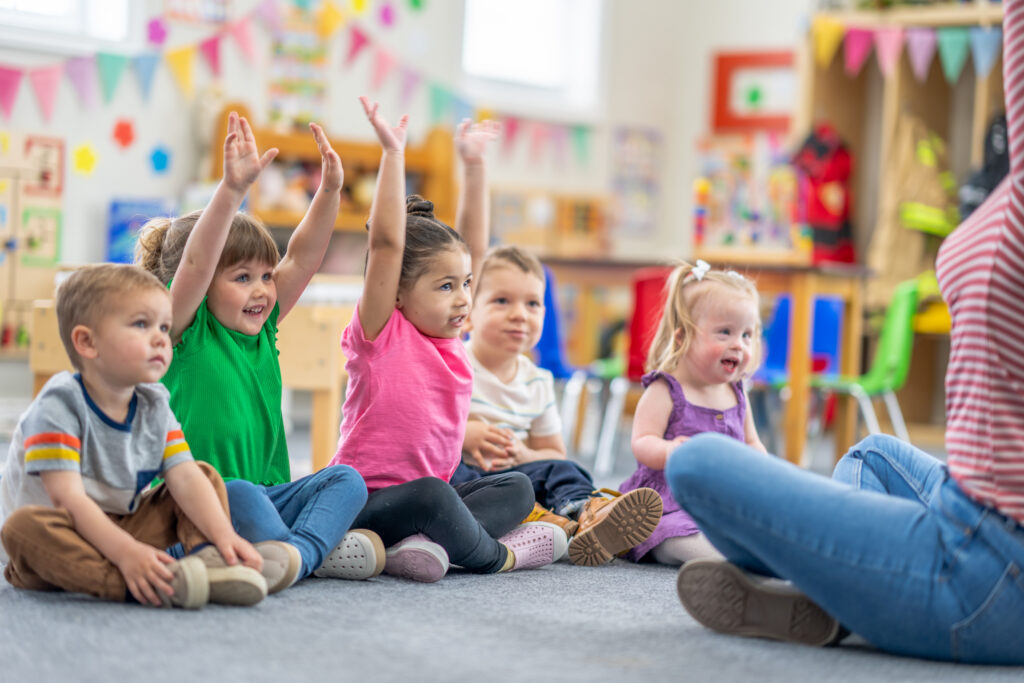
A preschool teacher sits on the floor of her classroom with her students in front of her as she leads them in a sing-along. The children are dressed casually and smiling as they following along with the actions.

Threes (Pre-Kindergarten Prep Academy)

Designed by passionate educators, our Pre-Kindergarten Prep Academy prepares your three-year-old for school success through expert-led instruction and milestone-aligned planning. We foster measurable growth by targeting key academic and social skills, including building sentence complexity, understanding stories, counting to 10, playing with friends, and mastering fine motor tasks like using scissors.

Our Pre-Kindergarten Prep Academy for three-year-olds is designed to channel your child’s boundless energy and curiosity into a fun, educational experience that prepares them for the start of their learning journey. We offer far more than traditional childcare; at our comprehensive preschool program our educators act as “curiosity-curators,” guiding children through a day that is both structured and child-led.. In our nurturing environment, your child will build the social, emotional, and academic skills needed to flourish in pre-K and achieve kindergarten readiness.
Each day follows a rhythm designed to build confidence and encourage exploration. Your three-year-old will build language and literacy skills through engaging story time, identifying letters and sounds, and participating in collaborative problem-solving. Through a blend of imaginative play, hands-on activities, and outdoor time, we focus on key developmental outcomes. Children learn to speak in longer sentences, answer questions about stories, and understand early math concepts like counting and patterns. They explore science by using tools and noticing differences in results.
This early learning program emphasizes the development of crucial social skills, such as cooperating with friends, following rules, and taking on classroom responsibilities. We also see children’s independence and imagination grow as they improve their gross motor and fine-motor coordination with activities like jumping one foot and utilizing scissors. Our three-year-olds program provides a head start in the academy journey
Read More

Learning Domains

Language and Emerging Literacy

  • Develops increasing abilities to understand and use language to communicate information, experiences, ideas, feelings, opinions, needs, questions, and for other varied purposes
  • Shows increasing ability to discriminate and identify sounds in spoken language
  • Shows progress in associating the names of letters with their shapes and sounds
  • Develops increasing ability to count in sequence to 10 and beyond
  • Shows increasing abilities to match, sort, put in a series, and regroup objects according to one or two attributes such as shape or size
  • Begins to participate in simple investigations to test observations, discuss, and draw conclusions
  • Progresses in abilities to create drawings, paintings, models, and other art creations that are more detailed, creative, or realistic
  • Shows growth in moving in time to different patterns of beat and rhythm in music
  • Participates in a variety of dramatic play activities that become more extended and complex, like various roles, locations, and stories
  • Develops growing capacity for independence in a range of activities, routines, and tasks
  • Demonstrates increasing capacity to follow rules and routines and use materials purposefully, safely, and respectfully
  • Shows progress in developing friendships with peers
  • Grows in eagerness to learn about and discuss a growing range of topics, ideas, and tasks
  • Grows in abilities to persist in and complete a variety of tasks, activities, projects, and experiences
  • Grows in recognizing and solving problems through active exploration, including trial and error, and interactions and discussions with peers
  • Grows in hand-eye coordination in building with blocks, putting together puzzles, reproducing shapes and patterns, stringing beads, and using scissors
  • Demonstrates increasing abilities to coordinate movements in throwing, catching, kicking, and bouncing balls
  • Shows growing independence in hygiene, nutrition, and personal care

Curriculum in Action

See how our educators teach our threes curriculum in the classroom.
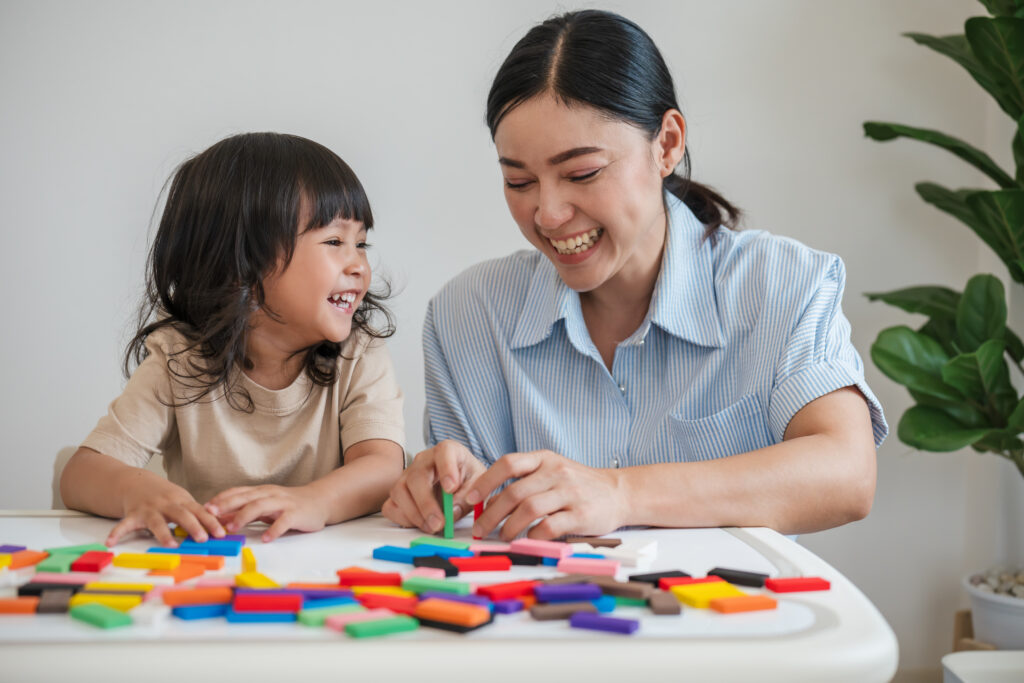
Activity: Domino Math
Skills Developed: Matching, counting, sensory exploration, comparing and contrasting
Learning Experience: Educators invite children to explore dominoes by stacking them, building with them, and examining the different patterns on each piece. Children are encouraged to describe what they notice. Teachers prompt questions such as: “What do you see on each side?” “What do the dominoes feel like?” “Can you stack them?” “Can you build with them?” This open exploration helps children compare and contrast textures, patterns, and quantities.
Children may try some of the suggested ideas or create new ways to explore the materials based on their own curiosity.
  • Line up dominoes by matching the patterns of dots on each end
  • Count the dots on each end and then count the total number of dots
Educators support early math learning by helping children line up dominoes according to the matching dot patterns on each end. Children can also count the dots on each side and then count the total number of dots to practice early numeracy skills.

Read More

threes

Pre-K (Kindergarten Prep Academy)

Designed by experienced educators, our Kindergarten Prep Academy program uses milestone-based  activities to build the critical thinking, academic, and social skills essential for school success. We target measurable growth in literacy, math, and science through structured, interactive activities that ensure your child masters kindergarten-readiness skills like writing their name, identifying the letters in their name, and demonstrating self-control and turn-taking.

Our Kindergarten Prep Academy is designed to help your four-year-old feel confident and prepared for the next step in their educational journey. This pre-K program is much more than childcare. We build the academic foundations children need for kindergarten, including writing their name, recognizing letters and sounds, identifying patterns, hearing syllables and rhyming words, and blending sounds in short words. Our curriculum provides a vibrant blend of exploration, creativity, and critical thinking in a structured environment. With a focus on differentiating learning to support your child’s needs in their learning journey.
In our prekindergarten program, your child will build crucial foundational skills for kindergarten readiness across all developmental areas. Daily activities focus on:
  1. Literacy: Learning to associate sounds with letters, identify at least 10 letters, and write their own name.
  2. Math: Building skills in sorting, making comparisons, and understanding positional words like “over” and “under.”
  3. Science and Discovery: Participating in simple investigations, predicting results, and recording information.
  4. Social-Emotional Growth: Expressing confidence in their abilities, advocating for themselves, and clearly expressing their needs, likes, and dislikes.
  5. Physical Development: Enhancing fine-motor control with pencils and paintbrushes, developing hand-eye coordination, and growing independence in personal hygiene.
Our goal is to spark a genuine love for learning that sets the stage for future academic success, ensuring your child is well-prepared for kindergarten and beyond.
Read More

Learning Domains

Language and Emerging Literacy

  • Uses an increasingly complex and varied spoken vocabulary
  • Develops increasing abilities to understand and use language to communicate information, experiences, ideas, etc.
  • Increases in ability to notice the beginning letters in familiar words
  • Begins to make use of one-to-one correspondence in counting objects and matching groups of objects
  • Begins to make comparisons between several objects based on a single attribute
  • Shows increased awareness and beginning understanding of changes in materials and cause-effect relationships
  • Progresses in abilities to create drawings, paintings, models, and other art creations that are more detailed, creative, or realistic
  • Participates in a variety of dramatic play activities that become more complex
  • Participates with increasing interest and enjoyment in a variety of music activities, including listening, singing, fingerplays, games, and performances
  • Begins to develop and express awareness of self in terms of specific abilities, characteristics, and preferences
  • Progresses in responding sympathetically to peers who are in need, upset, hurt, or angry; and in expressing empathy or caring for others
  • Shows progress in expressing feelings, needs, and opinions in difficult situations and conflicts without harming themselves, others, or property
  • Approaches tasks and activities with increased flexibility, imagination, and inventiveness
  • Demonstrates increasing ability to set goals and develop and follow through on plans
  • Develops increasing ability to find more than one solution to a question, task, or problem
  • Progresses in abilities to use writing, drawing, and art tools, including pencils, markers, chalk, and paintbrushes
  • Shows increasing levels of proficiency, control, and balance in walking, climbing, running, jumping, hopping, skipping, marching, and galloping
  • Shows growing independence in hygiene, nutrition, and personal care when eating, dressing, washing hands, brushing teeth, and toileting.

Curriculum in Action

See how our educators teach our pre-k curriculum in the classroom.
Activity: Pet Rocks
Skills Developed: Storytelling, imagination, fine motor skills, pre-writing
Learning Experience: Educators invite children to carefully look through a selection of rocks and choose their favorite one. Children then choose a small box that will become a home for the rock. Educators encourage children to explain why they chose that specific rock with prompts such as, “What makes it your favorite? Does it remind you of a rock you have seen before? Where did you find it?”
Children can use available materials to decorate their rock and make it special. Once their pet rock is complete, educators invite each child to tell a story about their rock. Prompts may include questions such as: Did the rock go through a snowstorm? Did it make it through a thunderstorm? What happened to the rock when the weather became very hot?
To extend the experience, children can also draw pictures of their pet rocks. These drawings help children practice pre-writing skills and support expressive storytelling.

Read More

Group of happy little children are sitting on the floor in the kindergarten and playing with toys.

School Age (Young Achiever's Club)

Our Young Achiever’s Club offers a safe and well-rounded before- and after-school experience that reinforces academics through structured homework support, S.T.E.A.M. projects, and science of reading activities. We balance academic enrichment with organized sports and creative exploration to foster your child’s social-emotional growth, physical development, and confidence.

Our Young Achiever’s Club offers a safe, nurturing, and enriching environment for school-age children (K-5) beyond school hours. This is more than just before- and after-care; it’s a well-rounded program that balances academics, independent activities, and cultivating friendships to support your child’s individual needs. We provide an encouraging space where your growing learner can continue to cultivate a love for learning while building a strong sense of community.
The Young Achiever’s Club is designed to build upon what your child learns during the school day. A typical afternoon rhythm includes supervised homework help, organized outdoor activities, and creative outlets, inviting children to explore their interests. Our curriculum fosters personal growth and a sense of belonging through hands-on S.T.E.A.M (Science, Technology, Engineering, Art, and Math) projects that encourage problem-solving and innovation. We also incorporate the science of reading to help students build upon foundational skills and become more confident readers.
In our program, your child will build crucial life skills, including character development, persistence, empathy, and teamwork. We foster healthy friendships and social-emotional growth by encouraging children to share their thoughts and feelings throughout daily activities.. With plenty of opportunities for physical activity, we help children improve motor skills and learn the value of sportsmanship, ensuring they have fun and make lasting memories.
Read More

Learning Domains

Language and Emerging Literacy

  • Identify and manipulate sounds within words
  • Practice reading words smoothly by blending sounds.
  • Analyze word structure and apply rules for word formation.
  • Learn about comparing and contrasting to make informed decisions based on data.
  • Observe and analyze interactions.
  • Practice teamwork and effective communication.
  • Participates in various forms of art, like painting, drawing, sculpting, and creating
  • Participates in increasingly more complex forms of dramatic play, like pretending to be familiar adults, making up unfamiliar scenarios, and using materials to symbolize a variety of objects
  • Enjoys a variety of music and movement, possibly making up dances to familiar songs and rhythms, or writing their own music
  • Actively engage in conversations and communication
  • Actively participates appropriately and cooperatively in group situations by respecting the needs of self and others.
  • Shows persistence when problem solving as well as flexibility and inventiveness in thinking.
  • Demonstrates eagerness to learn about and discuss new topics, ideas and tasks.
  • Works cooperatively with others to successfully achieve a goal or accomplish a task.
  • Asks questions and seeks new information with assistance, looks for new information and wants to know more.
  • Develop fundamental physical fitness components, such as strength, endurance, and flexibility.
  • Improve gross motor skills (e.g., running, jumping, throwing) and fine motor skills (e.g.,
    hand-eye coordination, balance).
  • Foster a growth mindset by learning the value of setting achievable goals and persisting in their efforts to reach them.

Curriculum in Action

See how our educators teach our school age curriculum in the classroom.
Activity: Making a Dinosaur Park
Skills Developed: Science, technology, engineering, art, mathematics
Learning Experience: Educators explain that each small group of children will be designing and creating a park that includes dinosaurs. Children are introduced to the idea by hearing a simple description of a made-up dinosaur zoo called Jurassic Park. Educators may say, “Jurassic Park was a famous made-up park that was a zoo for dinosaurs. There was a movie about this zoo in which the dinosaurs were alive. You will be creating your own mini Jurassic Park.”
Children work together in small groups to choose which dinosaurs they want to include. They then draw a plan for their Dinosaur Park and decide how they want to build it. This collaborative planning process encourages problem solving, teamwork, and creativity.
Educators provide a set of reference cards that show what different dinosaurs looked like. Each child in the group is responsible for creating one dinosaur based on the card they choose. As a group, children decide how the dinosaurs will live in their park and where each dinosaur will be placed.
This project invites children to combine science knowledge, engineering design, artistic expression, and early math skills while working together to create a shared vision.

Read More

Children, group and friends or drawing in classroom for creativity education, teamwork or project. Boys, girls and coloring pencil at desk for back to school art lesson or development, talk or youth

School Break Care

Our School Break Care program provides a safe and dynamic experience for elementary students, balancing structured learning with memorable fun during school breaks. Through themed weeks, hands-on projects, and exciting field trips, your child will build social skills, explore new interests, and develop lasting friendships in a trusted environment.

Our School Break Care program offers a safe, interactive, and fun environment where elementary students can continue learning and growing, even when school is out. We provide much more than just childcare during school breaks; our winter, spring, and summer camps are designed to offer educational  experiences that spark curiosity and creativity. Through a   blend of structured activities, independent exploration or choice-based activities , hands-on projects, and exciting outings, our dedicated team ensures every child has a memorable, joyful experience.
Every season brings something special at our camps.
During Winter Break Camp, children enjoy seasonal experiences designed to capture the wonder of winter, no matter what winter looks like for them.
Spring Break Camp gives kids a sneak peek at all the excitement of summer. With rotating daily themes, campers get the chance to explore new activities and discover what they love most.
Our Adventure Summer Camp immerses campers in 13 unique weekly themes. Each week invites children to dive into hands-on projects that strengthen skills in literacy, teamwork, science, exploration, and the arts all while having fun with friends.
No matter the time of year, our full-day camps are designed to inspire growth offering experiences that build confidence, spark curiosity, and encourage children to explore new interests.
While in our care , children are empowered to pursue their passions, develop new skills, and forge lasting friendships. Our program focuses on helping children build confidence, improve their problem-solving abilities, and self-expression to thrive outside the classroom. You can count on us to provide an unforgettable experience where your child will laugh, learn, and make lasting memories every season

Read More

Learning Domains

Language and Emerging Literacy

  • Experiments with sounds and babbling, building language skills
  • Uses voice to express feelings
  • Uses speech-like sounds; may begin to say words
  • Exhibits some sense of size, color and shape recognition of objects in immediate environment
  • Understands objects continue to exist even when they cannot be seen
  • Stacks toys/objects
  • Explores the world around them through their senses
  • Begins to explore food with hands
  • Becomes more aware of cause-and-effect relationships
  • Begins learning self-regulation and soothing skills
  • Differentiates between known people and strangers
  • Plays more interactively with others (peek-a-boo)
  • Focuses and reaches for objects
  • Begins developing problem-solving skills
  • Enjoys repetition of activities, practicing and figuring out how things work
  • Rolls over, grasps with both hands and begins to sit with assistance
  • Builds large muscles through crawling and standing
  • Walks with adult support; may begin to walk alone

Give Your Child a Great Start!

Families deserve peace of mind, and children deserve exceptional learning experiences. Our educators bring our curriculum to life through fun, age‑appropriate activities that nurture creativity, confidence, and a love of learning. See how your child can thrive in one of our classrooms.